

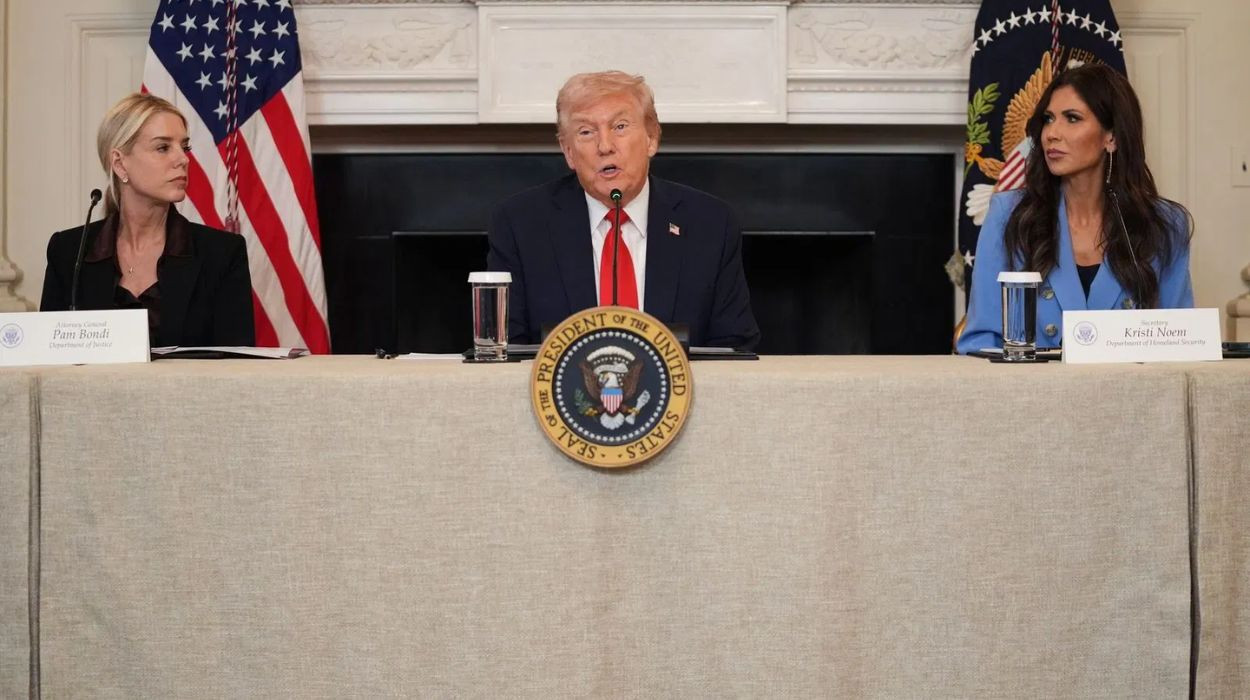
On October 23, 2025, President Donald Trump convened a critical roundtable at the White House to spotlight his administration’s aggressive and sweeping crackdown on immigration-related crime, drug cartels, and human trafficking networks operating within the United States. The event, held in the State Dining Room, gathered senior law enforcement and administration officials to discuss the significant progress achieved by the Homeland Security Task Forces, a hallmark initiative Trump established via executive order on the first day of his second term.
Establishment and Mission of Homeland Security Task Forces
The Homeland Security Task Forces (HSTFs) were created by President Trump’s executive order titled “Protecting the American People from Invasion.” This sweeping directive explicitly charged Attorney General Pam Bondi and Homeland Security Secretary Kristi Noem with forming state-level task forces to dismantle criminal cartels, foreign gangs, and transnational organizations throughout the U.S.
These task forces have a clearly focused mandate to end cross-border human smuggling and trafficking networks, with special attention on offenses involving children. They are authorized to deploy every available law enforcement tool to rigorously enforce U.S. immigration laws and tackle the rise of organized crime linked to immigration channels.
Scale of Operation: Arrests, Seizures, and Impact
President Trump enthusiastically detailed the tangible success of these operations during the roundtable, emphasizing their “spectacular” results achieved in just a few weeks. The task forces have arrested more than 3,000 cartel leaders, operatives, and gang members, marking what Trump called “the largest number of cartel arrests in American history.”
These arrests targeted major cartels including the New Generation Cartel, Sinaloa Cartel, LNFM Cartel, MS-13, and Tren de Aragua. Trump characterized these groups as
“the ISIS of the western hemisphere,”
underscoring the existential threat they pose to U.S. national security.
Attorney General Pam Bondi highlighted that approximately 91 tons of illicit drugs have been seized — enough to fill four eighteen-wheelers — alongside illegal firearms and the removal of dangerous foreign terrorists. These results showcase the scale and intensity of the crackdown against drug and crime cartels infringing on American communities.
Government Coordination and Policy Priorities
A central theme articulated by White House spokeswoman Abigail Jackson was the significance of leadership and streamlined coordination within federal agencies. As she stated,
“The President’s Homeland Security Task Forces are a landmark achievement that highlight what the federal government can achieve with a leader like President Trump who is willing to slash red tape, increase coordination and put the safety of the American people first.”
Jackson further emphasized that the American public is safer today and that these efforts have only just begun, presenting the task forces as a model of what resolute federal action can accomplish when headed by strong leadership.
Attorney General Bondi and Secretary Noem have led the operational and strategic command of these task forces, working to dismantle cartel infrastructure, prevent human trafficking, and address the intertwined issues of illegal immigration and organized crime.
Trump’s Stance on Immigration and Crime Enforcement
President Trump framed the crackdown within a national security imperative, pledging to treat cartels as core threats rather than mere criminal entities. He declared,
“Under the Trump Administration, we're finally treating the cartels as the core national security threat that they really are… Our objective is to ELIMINATE it.”
This marks a decisive break from past administrations that tended to seek mitigation or containment rather than outright elimination. The President’s zero-tolerance approach hinges on robust enforcement and the disruption of supply chains and trafficking networks at every level.
Federal Agent Deployment to High-Crime Areas
Plans to deploy federal agents to combat crime and immigration violations are underway, targeting jurisdictions including San Francisco, a city identified as especially vulnerable to cartel-related violence and illegal entries. Though earlier proposals to send National Guard troops were reconsidered amid political controversy, federal officers, primarily from Customs and Border Protection, are being dispatched to increase enforcement.
This redeployment reflects the administration’s commitment to prioritize public safety and enforce immigration laws even in jurisdictions resistant to federal intervention.
Expansion into Military Operations Against Trafficking
The Trump administration has expanded its operation scope beyond borders, conducting military strikes on suspected drug-courier boats in the Pacific, which have resulted in at least 37 deaths. These operations are part of a coordinated “narco-trafficking” campaign to disrupt international trafficking routes.
President Trump has signaled willingness to request Congressional approval for potential ground operations in Venezuela if existing interdiction efforts do not curb the cartels adequately, underscoring an integrated approach combining domestic law enforcement with overseas military actions.
Political and Social Dynamics
While the administration’s enforcement policies have been lauded by supporters as robust and necessary, they have sparked political opposition, particularly from Democratic leaders. Governors of Democratic-led cities have resisted federal troop or agent deployments, challenging the administration’s authority and framing the crackdown as overly harsh or politically motivated.
Critics warn of the risks of overreach and potential civil rights infringements amid aggressive immigration enforcement. Nonetheless, Deputy Attorney General Todd Blanche defended the policies, dismissing worries that immigration enforcement detracts from other criminal investigations, emphasizing the administration’s focus on national security threats.