

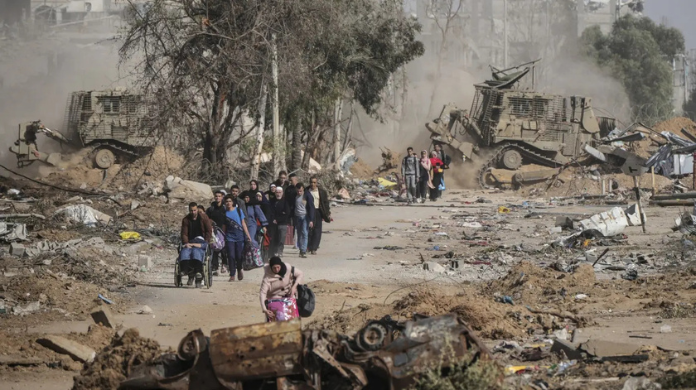
The Gaza Strip is enduring one of the most severe humanitarian crises in recent history. Since the outbreak of hostilities in October 2023, the civilian population has been subjected to relentless military operations, a crippling blockade, and a systematic denial of humanitarian aid. The recent escalation, marked by Israeli military attacks killing Palestinians seeking aid at distribution points and the issuance of new expulsion orders, has intensified concerns about grave violations of human rights and international humanitarian law. This article critically examines the unfolding crisis, focusing on the human rights violations, forced displacement, and the devastating impact of military operations on Gaza’s civilian population, drawing on verified statistics, eyewitness accounts, and statements from key stakeholders.
The Humanitarian Catastrophe: Deadly Attacks on Aid Seekers
Since the Gaza Humanitarian Foundation (GHF) began distributing aid in late May 2025, the situation has deteriorated sharply. According to Gaza’s Ministry of Health and corroborated by the United Nations Office for the Coordination of Humanitarian Affairs (OCHA), at least 274 Palestinians have been killed and over 2,000 injured near aid distribution points across Gaza. On June 14 alone, Israeli artillery and drone strikes killed at least 79 Palestinians, many while queuing for food near the Netzarim Corridor, a GHF distribution site.
Hospitals such as Al-Awda and Al-Aqsa in central Gaza have been overwhelmed with casualties. Al-Awda Hospital received eight bodies and 125 wounded following drone strikes targeting crowds near aid centers. The Gaza civil defence agency reported similar incidents in Rafah and the Sudanese area, with at least 23 killed near aid trucks.
Eyewitnesses describe these distribution points as “execution sites”, a chilling testament to the dangers civilians face even when seeking basic sustenance. Tareq Abu Azzoum, a local reporter, noted,
“Many Palestinians are beginning to perceive GHF distribution centers as execution sites, yet they feel compelled to risk their lives to obtain food.”
This stark reality underscores the desperation induced by the blockade and ongoing hostilities.
Israel’s Military Stance and the Question of Civilian Protection
The Israeli Defense Forces (IDF) acknowledge firing warning shots and engaging individuals they deem security threats near aid sites. However, they deny intentionally targeting civilians. The IDF claims that some attacks were responses to perceived threats, including individuals deviating from designated safe routes or approaching troops aggressively.
Despite these claims, the disproportionate civilian casualties and repeated targeting of vulnerable populations have drawn condemnation from international bodies. The United Nations and humanitarian organizations criticize the new aid distribution system under GHF, which replaced the UN’s role, as inadequate and unsafe. A UN spokesperson stated,
“GHF has, from a humanitarian standpoint, been a failure. They are not fulfilling the role of a humanitarian operation, which is to provide assistance to individuals safely and securely.”
This disconnect between military assertions and ground realities raises serious concerns about compliance with international humanitarian law, particularly the principles of distinction and proportionality, which require parties to distinguish between combatants and civilians and to avoid excessive civilian harm.
Forced Displacement and Expulsion Orders: A Strategy of Territorial Control
Parallel to the attacks on aid seekers, Israel has issued new expulsion orders compelling Palestinians to relocate within Gaza. The authorities have designated three so-called “concentration zones” in southern Gaza and are forcing residents from northern and central Gaza to move into these areas. Those expelled are barred from returning, effectively shrinking the territory accessible to Gaza’s 2.3 million residents.
The United Nations and legal experts warn that these forced displacements violate international humanitarian law and may constitute war crimes. The UN Independent International Commission of Inquiry on the Occupied Palestinian Territory has condemned Israel’s policies of destruction, starvation, and forced displacement as potentially criminal acts. Navi Pillay, Chair of the UN Commission, declared,
“We are seeing more and more indications that Israel is carrying out a concerted campaign to obliterate Palestinian life in Gaza. Israel’s targeting of the educational, cultural, and religious life of the Palestinian people will harm present and future generations, hindering their right to self-determination.”
These measures exacerbate the humanitarian crisis by uprooting already vulnerable populations, destroying homes and infrastructure, and increasing overcrowding in the designated zones, which lack adequate resources and services.
The Scale of the Crisis: Death Toll, Displacement, and Infrastructure Destruction
The conflict’s human toll is staggering. According to the Gaza Ministry of Health and OCHA reports:
Since October 7, 2023, over 55,000 Palestinians have been killed, with more than 127,000 injured. Women and children constitute more than half of the fatalities.
Between March 18 and June 11, 2025, over 664,800 Palestinians were displaced within Gaza due to military operations and bombardments.
The blockade and hostilities have destroyed critical infrastructure, including hospitals, schools, water and sanitation networks, and electricity grids, further worsening living conditions.
Aid workers themselves have not been spared. Since the conflict began, at least 463 aid workers have been killed, including UN staff and local humanitarian personnel, severely hampering relief efforts.
Eyewitness and Medical Testimonies: The Human Face of the Crisis
Medical personnel and survivors provide harrowing accounts of the violence. Mohammad al-Mughayyir, a civil defence official, reported,
“Al-Awda hospital in central Gaza received eight bodies and 125 wounded after Israeli drone strikes targeted people gathering near an aid distribution centre.”
Many victims were civilians, including women, children, and elderly individuals.
Ahmed al-Masri, a Gaza resident, described the scene at an aid site:
“There were wounded, dead, and martyrs... It’s a trap.”
The desperation of the population is evident as thousands continue to risk their lives for food amid the blockade and bombardments.
Legal and Ethical Implications: Violations of Human Rights and Humanitarian Law
The targeting of civilians seeking humanitarian aid, the forced displacement of populations, and the destruction of civilian infrastructure raise serious legal and ethical questions. Under international humanitarian law, parties to conflict must distinguish between civilians and combatants and protect civilians from harm. The use of starvation as a method of warfare and forced population transfers are prohibited under the Geneva Conventions.
The UN Commission of Inquiry and human rights organizations have documented evidence suggesting that Israeli actions may amount to war crimes and crimes against humanity. Amnesty International has called for independent investigations and accountability, emphasizing that
“the failure to protect civilians and ensure safe humanitarian access is costing lives and livelihoods.”
International Response and Challenges
International reactions have been marked by concern and calls for urgent action. The United Nations, African Union, and numerous human rights organizations have condemned the attacks and displacement orders, urging all parties to respect international law and facilitate humanitarian access.
However, concrete international interventions remain limited. Geopolitical complexities, including Israel’s strategic alliances and the broader regional dynamics, constrain the scope of diplomatic pressure and peacekeeping efforts.
Humanitarian organizations continue to provide aid under extremely challenging conditions, but ongoing hostilities and restrictions severely limit their reach and effectiveness.
Urgent Need for Protection and Accountability
The killing of aid seekers in Gaza and the forced displacement of its population represent a grave escalation in an already dire humanitarian crisis. The repeated attacks on civilians seeking food, combined with policies of forced expulsion, constitute serious violations of human rights and international humanitarian law.
The international community must intensify efforts to protect civilians, ensure safe and impartial humanitarian access, and hold perpetrators accountable. Without urgent and sustained action, the suffering of Gaza’s population will deepen, and the prospects for peace and justice will diminish further.